

Wind-Solar Complementary System Solution
I. System Overview
The wind-solar complementary system is an efficient renewable energy utilization solution. It combines wind power generation and solar photovoltaic power generation technologies, making full use of the complementary characteristics of wind energy and solar energy in terms of time and season to provide stable and reliable power supply for various loads. This system is especially suitable for remote areas, off-grid locations, or application scenarios with high requirements for power stability. It can effectively reduce the reliance on traditional energy sources, lower operating costs, and at the same time has significant advantages such as environmental protection and energy conservation.
II. System Components
Wind Power Generation Part
Wind Turbine: Select high-efficiency wind turbines with low wind speed start-up. Choose appropriate power according to the application scenario and load requirements, such as different specifications from 500W to 10kW. Its blade design is optimized to efficiently capture wind energy at different wind speeds and convert it into mechanical energy.
Tower: Supports the wind turbine, ensuring that its installation height reaches the optimal wind energy capture position. At the same time, it has sufficient strength and stability to withstand strong winds and other severe weather. The tower height is usually determined according to the local wind resource conditions, generally between 10 - 30 meters.
Controller: Monitors and controls the output of the wind turbine, realizing overvoltage, overcurrent, undervoltage, overload and other protection functions to ensure the safe and stable operation of the system. At the same time, the controller can automatically adjust the working state of the wind turbine according to the wind speed to achieve maximum power tracking.
Solar Power Generation Part
Solar Panels: Use monocrystalline silicon or polycrystalline silicon solar panels, which have high conversion efficiency and long service life. According to the load power and lighting conditions, reasonably configure the number and capacity of solar panels to ensure that enough electrical energy can be generated under sufficient sunlight.
Mounting Bracket: Used to install and fix solar panels. It can be adjusted according to the local lighting angle and geographical conditions to make the solar panels always in the best lighting position and improve the power generation efficiency.
PV Controller: Manages and controls the output of solar panels, preventing the panels from being damaged under abnormal conditions such as overcharging and over discharging. At the same time, it realizes intelligent charging management of the battery to extend the service life of the battery.
Energy Storage Part
Battery Bank: Select energy storage devices such as lead-acid batteries and lithium batteries to store the excess electrical energy generated by wind power generation and solar power generation, so as to provide power for the load when there is no wind or no sunlight. The capacity of the battery bank is comprehensively determined according to factors such as load power, power consumption duration, and the backup requirements of the system, ensuring that it can meet the power consumption needs of the load under different working conditions.
Battery Management System (BMS): Monitors and manages the battery bank in real-time, including parameters such as battery voltage, current, and temperature. It realizes balanced charging and discharging of the battery, prevents the battery from overcharging, over discharging, and overheating, extends the battery service life, and improves the safety and reliability of the battery.
Inverter Part
Inverter: Converts the direct current output by the battery bank into alternating current to meet the power consumption needs of AC loads. The inverter has the characteristics of high efficiency, high stability, and low harmonic output. You can choose an appropriate inverter according to the load type and power. For example, pure sine wave inverters are suitable for loads with high requirements for power quality, and modified sine wave inverters are suitable for general loads.
Monitoring and Protection Part
Monitoring System: Monitors the operating status of the system in real-time, including the working parameters of equipment such as wind turbines, solar panels, battery banks, and inverters, such as voltage, current, power, temperature, etc. The data is fed back to the user through a display screen or remote communication method, facilitating the user to understand the system operation status in a timely manner, and conduct fault diagnosis and maintenance.
Protection Devices: Equipped with various protection functions such as overvoltage protection, overcurrent protection, undervoltage protection, leakage protection, and lightning protection, ensuring that the system can automatically cut off the circuit under various abnormal conditions to protect equipment and personnel safety.
III. System Topology Diagram
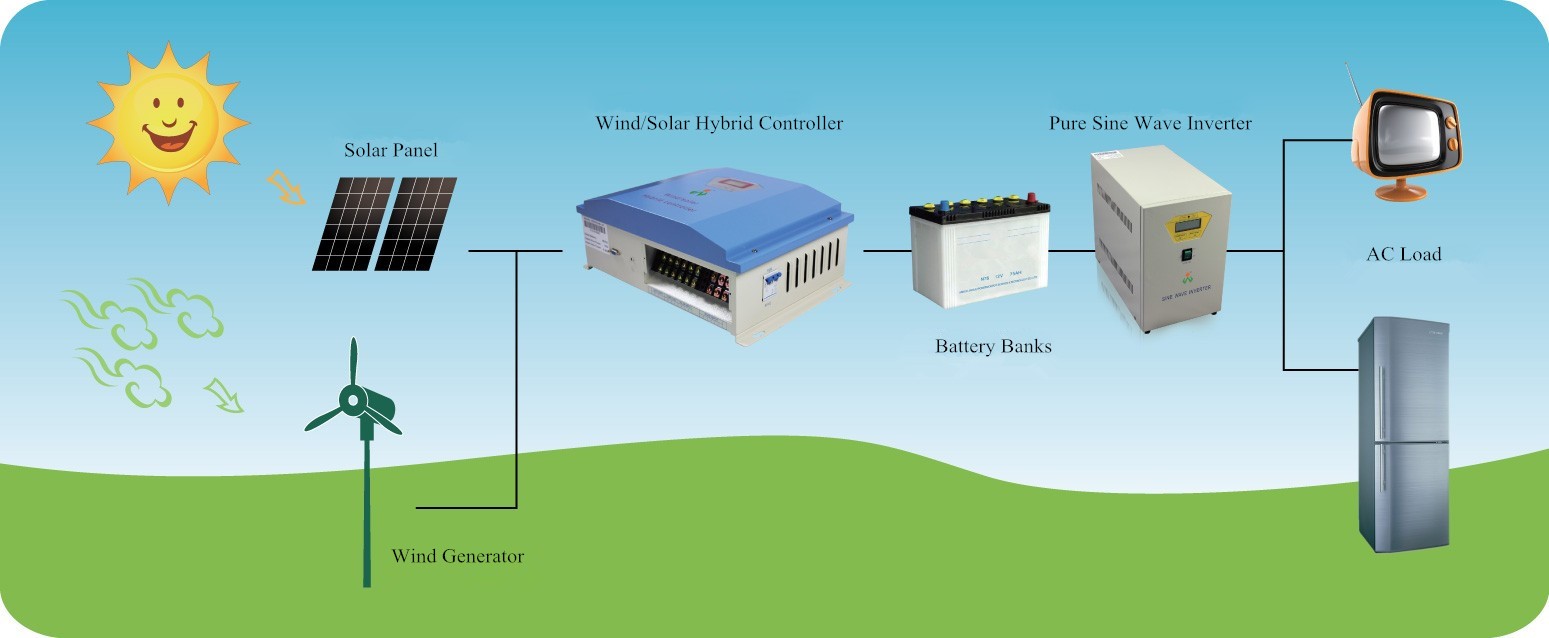
IV. System Working Principle
When there is wind and sunlight, the wind turbine and solar panels work simultaneously, converting wind energy and solar energy into electrical energy respectively. The alternating current output by the wind turbine is converted into direct current through the controller, and the direct current output by the solar panels passes through the PV controller. Both jointly charge the battery bank, and at the same time, part of the electrical energy can be directly supplied to DC loads.
When there is only sunlight and no wind, the solar panels work alone. The generated electrical energy charges the battery bank through the PV controller and supplies power to DC loads. If the load power demand is large at this time, the battery bank can also cooperate with the solar panels to supply power to the load.
When there is only wind and no sunlight, the wind turbine works. The electrical energy it outputs is converted into direct current through the controller and then charges the battery bank and supplies power to DC loads. Similarly, if the load power demand exceeds the output capacity of the wind turbine, the battery bank can supplement the power supply.
When there is no wind and no sunlight, the battery bank supplies power to the load. At this time, the inverter converts the direct current in the battery bank into alternating current to meet the power consumption needs of AC loads. The monitoring system monitors the power of the battery bank in real-time. When the power is lower than the set threshold, it sends an early warning signal to prompt the user to take corresponding measures, such as starting a backup power supply.
V. System Advantages
Strong Energy Complementarity: Wind energy and solar energy are complementary in terms of time and season. For example, solar power generation dominates during the day when the sun is sufficient, while wind power generation plays a role at night or on cloudy days, enabling the system to have a stable power output at different times, improving energy utilization efficiency and power supply reliability.
Environmental Protection and Energy Conservation: Using renewable energy to generate electricity does not produce greenhouse gas emissions and other pollutants, which is environmentally friendly and in line with the requirements of sustainable development. At the same time, it reduces the reliance on traditional fossil energy sources, reduces energy consumption and operating costs.
Independent Power Supply: The system can operate independently without relying on the external power grid. It is especially suitable for remote areas, off-grid locations, or areas with unstable grid power supply, providing reliable power protection for users. It can also continue to supply power in the face of emergencies such as natural disasters.
Convenient Installation and Maintenance: The system components are modularly designed, easy to install, and can be flexibly configured according to actual needs. Daily maintenance mainly includes equipment cleaning, inspection, and maintenance. The maintenance workload is relatively small, and the maintenance cost is low.
Good Expandability: According to the user's power consumption needs and future development plans, it is convenient to expand the system, increase the number of wind turbines, solar panels, or battery banks to meet the growing power demand.
VI. Application Scenarios
Power Supply in Remote Areas: In remote areas far from the power grid, such as mountainous areas, pastoral areas, and islands, the wind-solar complementary system can be used as an independent power supply to provide stable and reliable power for residents' lives and production, improve local power supply conditions, and promote economic development.
Road Lighting: Applying the wind-solar complementary system in the lighting systems of urban roads, expressways, rural roads, etc., can realize the automatic control and energy-saving operation of street lights, reduce cable laying and maintenance costs, and at the same time improve the reliability and stability of the lighting system.
Power Supply for Communication Base Stations: Provide stable power protection for communication base stations, ensuring that the base stations can still operate normally when the mains power is cut off or the power grid is unstable, improving the coverage and stability of the communication network, and reducing communication interruptions caused by power outages.
Agricultural Irrigation: Drive irrigation equipment such as water pumps to achieve a green and energy-saving irrigation method, meet the power needs of agricultural production, improve irrigation efficiency, reduce agricultural production costs, and at the same time reduce the reliance on traditional energy sources and promote the sustainable development of agriculture.
Power Supply for Outdoor Facilities: Provide power for outdoor facilities such as billboards, surveillance cameras, and meteorological monitoring stations, enabling them to work continuously and stably in the wild environment without laying complex power supply lines, reducing installation and maintenance costs.
VII. System Configuration Suggestions
Determine System Capacity According to Load Requirements: First, clarify the type, power size, and power consumption duration of the load. Based on these parameters, calculate the required power generation power and energy storage capacity of the system. For example, for an AC load with a power of 1kW and an electricity consumption of 8 hours per day, considering the system conversion efficiency and a certain margin, the total power generation power of the selected wind turbine and solar panels should be no less than 1.5kW, and the capacity of the battery bank should be able to meet the power consumption needs of the load for at least 8 hours without wind and sunlight.
Consider Local Wind Resources and Lighting Conditions: Wind resources and lighting conditions vary greatly in different regions. When choosing wind turbines and solar panels, fully consider factors such as local wind speed, lighting intensity, and sunshine hours. In areas with rich wind resources, the proportion of wind turbines can be appropriately increased; in areas with sufficient sunlight, the configuration of solar panels can be increased. Through a reasonable assessment and utilization of local resources, the best performance and economic benefits of the system can be achieved.
Reasonably Select Equipment Brands and Models: There are numerous brands of wind-solar complementary system equipment on the market, and the quality varies. To ensure the reliability and stability of the system, choose products from well-known brands with reliable quality. When choosing a wind turbine, pay attention to parameters such as its starting wind speed, rated wind speed, and output power curve; when choosing solar panels, pay attention to indicators such as their conversion efficiency, open-circuit voltage, and short-circuit current; for battery banks and inverters, consider factors such as their capacity, charge and discharge efficiency, and service life. At the same time, ensure the compatibility and matching of various devices to ensure the overall performance of the system.
Configure a Complete Monitoring and Protection System: The monitoring and protection system is an important part to ensure the safe and stable operation of the wind-solar complementary system. Configure a monitoring system with functions such as real-time monitoring, data recording, and fault alarm, so that users can understand the operation status of the system in a timely manner. At the same time, equip a complete set of protection devices, including overvoltage, overcurrent, undervoltage, leakage, lightning protection and other protection functions, ensuring that the system can automatically cut off the circuit under various abnormal conditions to protect equipment and personnel safety.
VIII. System Installation and Commissioning
Preparation before Installation: Before installing the wind-solar complementary system, it is necessary to survey the installation site to ensure that the site meets the equipment installation requirements. For example, the installation position of the wind turbine should be selected in an open, well-ventilated place without obstacles, and the installation position of the solar panels should be able to fully receive sunlight and avoid shadow shielding. At the same time, prepare the required installation tools and materials, such as cables, brackets, bolts, etc., and inspect the equipment to ensure that the equipment is undamaged and the accessories are complete.
Equipment Installation: Install the wind turbine, tower, solar panels, mounting brackets, controller, inverter, battery bank and other equipment in sequence according to the system topology diagram and equipment installation instructions. During the installation process, pay attention to the firm and reliable connection between various devices, and the cable laying should comply with electrical safety specifications to avoid cable crossing, winding, and damage. At the same time, ensure that the equipment is well grounded to prevent lightning strikes and electric leakage accidents.
System Commissioning: After the equipment is installed, conduct system commissioning. First, check whether the wiring of the system is correct and whether the parameter settings of each device meet the requirements. Then, start the wind turbine and solar panels respectively, observe whether their output voltage and current are normal, and whether the controller can effectively control and protect them. Next, connect the battery bank to the system, check whether the charging and discharging functions are normal, and whether the inverter can convert direct current into alternating current and supply power to the load normally. During the commissioning process, pay attention to observing the operation status of the system, discover and solve problems in a timely manner, and ensure that the system can operate normally and stably.
IX. System Maintenance and Upkeep
Regular Equipment Inspection: Regularly inspect equipment such as wind turbines, solar panels, controllers, inverters, and battery banks. Check whether the appearance of the equipment is damaged or deformed, whether the connection parts are loose, and whether the cables are aging or damaged. At the same time, check whether the operating parameters of the equipment are normal, such as the rotation speed and output power of the wind turbine, the voltage and current of the solar panels, and the voltage and capacity of the battery bank. Timely discover and handle equipment failures.
Equipment Cleaning: Regularly clean the solar panels and the blades of the wind turbine to remove dust, dirt, and debris on the surface to ensure the normal operation of the equipment and power generation efficiency. When cleaning the solar panels, use a soft cleaning cloth and neutral detergent to avoid scratching the surface of the panels; when cleaning the blades of the wind turbine, pay attention to safety and use special cleaning tools and equipment.
Maintenance of Battery Bank: The battery bank is an important part of the wind-solar complementary system, and its performance directly affects the power supply reliability and service life of the system. Regularly inspect and maintain the battery bank, including checking whether there are abnormal conditions such as bulging and liquid leakage in the appearance of the battery, measuring parameters such as battery voltage, current, and electrolyte density, and timely replenishing electrolyte and performing balanced charging. At the same time, pay attention to keeping the battery room well ventilated to avoid battery overheating and explosion risks.
Update Equipment Software: With the continuous development of technology and the operating requirements of the system, some equipment may need to update the software to improve performance and functions. Pay attention to the software update information released by the equipment manufacturer, and timely update the software of the controller, inverter and other equipment to ensure that the system can always maintain the best operating state.
X. Summary
As an efficient, environmentally friendly, and reliable renewable energy utilization solution, the wind-solar complementary system has broad application prospects and significant economic benefits. Through reasonable system design, equipment selection, installation, commissioning, and maintenance, the long-term stable operation of the system can be ensured, providing high-quality power services for various users. In today's increasingly tense energy situation and increasingly strict environmental protection requirements, the promotion and application of the wind-solar complementary system are of great significance for promoting the sustainable development of energy and improving the ecological environment.