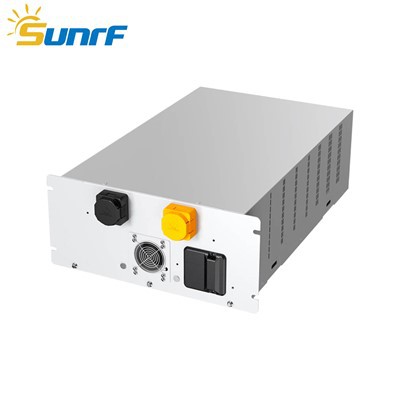
The solar power supply system for communication base stations is an innovative solution that utilizes solar photovoltaic power generation technology to provide electricity for communication base stations. It mainly consists of solar panels (solar cell arrays), solar charge controllers, solar battery banks, inverters, and other auxiliary equipment (such as combiner boxes, photovoltaic mounts, etc.). These components perform their respective functions, jointly ensuring the stable and efficient operation of the system.
Solar panels, the core of the entire system, are responsible for efficiently converting solar photons into electrical energy, thus driving the normal operation of communication base stations. Monocrystalline silicon cells are highly regarded for their stable performance, long lifespan (usually up to 25 years), and high conversion efficiency, making them the most commonly used type of solar cells.
The solar charge controller monitors and manages the operating status of the entire system. It also protects the batteries from overcharging and over-discharging. In low-temperature environments, it has a temperature compensation function to ensure the stable operation of the system under various conditions. The new MPPT (Maximum Power Point Tracking) controller can further enhance the utilization efficiency of solar energy, making the system more efficient and energy-saving.
The solar deep-cycle battery bank stores the electrical energy generated by the solar panels, ensuring a stable power supply to the communication base stations even when there is no sunlight or insufficient sunlight. Typically, these batteries are valve-regulated maintenance-free lead-acid batteries. In low-temperature environments, solar gel batteries are required to ensure a stable power supply and the long-term durability of the batteries.
Inverters also play a crucial role in the system. Since the direct output of solar energy is usually 12VDc, 24VDc, or 48VDc, while some devices in the system require 220V or 110V AC power, inverters can efficiently convert the DC electrical energy generated by the solar photovoltaic power generation system into AC electrical energy to meet the needs of various devices.
The working principles of the solar power supply system for communication base stations mainly include two types: the independent solar photovoltaic power generation system and the photovoltaic complementary system. The independent solar photovoltaic power generation system operates in an island mode, where the electrical energy output from the photovoltaic system is not integrated into the AC grid but directly supplies power to the load or charges the battery. The photovoltaic complementary system directly applies solar photovoltaic power as an energy-saving source in base station rooms where mains power is available, achieving complementary power supply between solar energy and mains power and further improving the reliability and stability of the system.
This system has multiple significant advantages. Firstly, it is safe and reliable, independent of the external power grid, thus avoiding power outages caused by grid failures. Secondly, the system has a simple structure, is easy to install and maintain, and is especially suitable for use in remote areas. Finally, during operation, the system does not produce any pollutants or noise, fully conforming to the requirements of environmental protection and sustainable development. For the power and communication industry, the adoption of solar power supply systems not only helps reduce reliance on traditional energy sources but also significantly reduces carbon emissions, contributing to the achievement of the carbon neutrality goal.
The application scope of the solar power supply system for communication base stations is extensive, covering many fields such as microwave relay systems, mobile or Unicom highway relay transmission and reception systems, and forest fire prevention monitoring stations. In remote areas or islands where it is difficult to access the traditional power grid, the solar power supply system can provide stable power support for power and communication base stations, ensuring the stability and coverage of communication signals. In addition, during natural disasters or emergencies, the solar power supply system can also serve as an emergency power source to provide power support for power and communication base stations, ensuring the normal operation of the communication network and the timely transmission of information.
In conclusion, the solar power supply system for communication base stations, with its unique advantages, is playing an increasingly important role in the field of power and communication. It can not only provide stable power support for base stations in remote areas but also serve as a solution for emergency power sources and green data centers. With the continuous progress of technology and the further reduction of costs, the solar power supply system for communication base stations will become one of the mainstream power supply methods in the future power and communication field, contributing more to the construction of a green, stable, and reliable communication network.